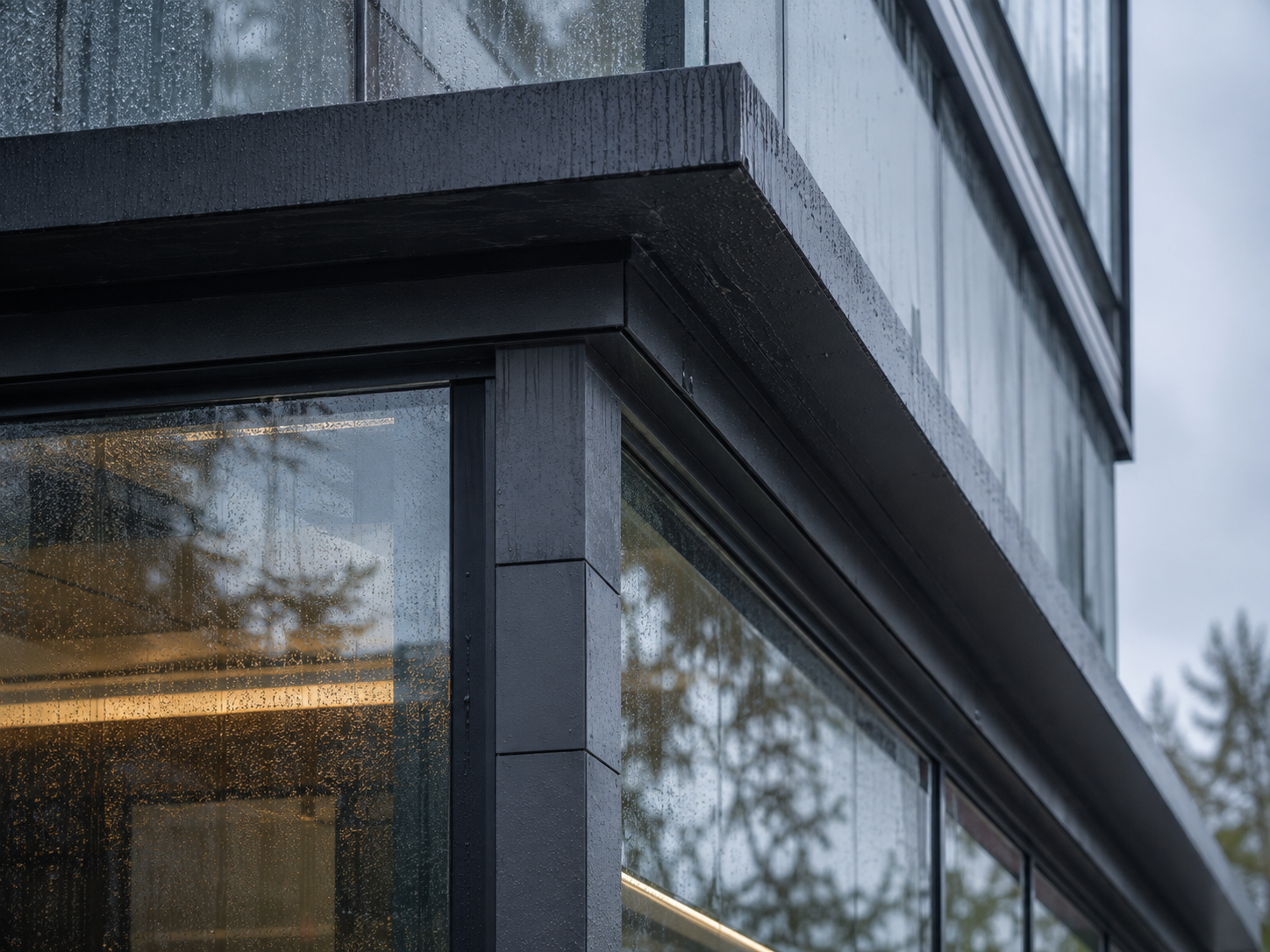
Why buildings in the Southeast fail differently — and how we find the problem before it becomes damage.
This page walks through how CBEPC approaches moisture and mold risk in mixed-humid climates like Charlotte, NC — the reasoning, the tools, and the sequence we follow. It's a look at our methodology, illustrated with a representative scenario, rather than a report on one specific completed project.
Charlotte and the broader Southeast sit in IECC Climate Zones 3A and 4A — mixed-humid climates with long, humid cooling seasons and moderate heating seasons. That combination creates a problem that heating-dominated climates rarely have to deal with: vapor drive that reverses direction with the seasons.
In winter, warm, moist indoor air pushes outward through the wall assembly. In summer, it's the opposite — hot, humid outdoor air pushes inward, while air conditioning keeps interior surfaces and cavity components below the dew point of that humid air. An assembly detailed only for winter-direction vapor drive — a vapor-impermeable finish on the interior, for example — can trap moisture against a cold surface all summer long.
This is exactly how one of the Southeast's most common building-science failures happens: vinyl wall covering or oil-based paint on interior gypsum, combined with a wall cavity that isn't well air-sealed, lets humid air reach the cool backside of that interior finish during cooling season. The wall can't dry inward because the finish won't let vapor through, and mold grows on the gypsum board behind the wallpaper — often for months before anyone notices it.
Review the assembly's permeance stack-up for double vapor barriers, HVAC dehumidification capacity against the building's envelope and occupancy loads, and moisture sources like crawlspaces, roof penetrations, and grading.
Screen with the Glaser method, then run full hygrothermal (WUFI) simulations against local climate data. Verify in the field with moisture meters, infrared thermography, and blower-door-assisted diagnostics to find humid-air infiltration paths.
Recommend assembly changes — vapor-permeable or smart membranes, continuous exterior insulation to keep sheathing above the interior dew point, air-sealing, and right-sized dehumidification — prioritized by risk and constructibility.
After implementation, verify with follow-up diagnostics and a season of indoor temperature/humidity monitoring to confirm surfaces and RH stay outside the range where mold can establish.
To make this concrete, consider a typical wood-framed multifamily building in Charlotte's mixed-humid climate — a common building type in our service area, used here as an illustrative example rather than a specific project.
Every step above is backed by tools you can try yourself. Screen an assembly's condensation risk with the Glaser Method Calculator, explore the air properties behind dew point and vapor drive with the Psychrometric Chart, or run measured temperature and humidity data through the Mold Growth Simulator to see where the mold-growth threshold gets crossed.
CBEPC is led by Vincent Ellis, a PHIUS Certified Consultant (CPHC®) with a Master of Building Science, using WUFI and THERM modeling to evaluate real-world enclosure performance in exactly these conditions.